Operations & Maintenance
Chapter 12 · Unattended Surveillance Site Design Guide
Effective operations and maintenance (O&M) is the foundation of long-term system reliability for unattended surveillance sites. Because no personnel are present at the site, O&M relies on three pillars: remote monitoring through a Network Management System (NMS), scheduled preventive maintenance visits, and rapid corrective maintenance response when failures are detected. This chapter defines the O&M framework, key performance indicators, maintenance schedules, and escalation procedures for a professional unattended site management program.
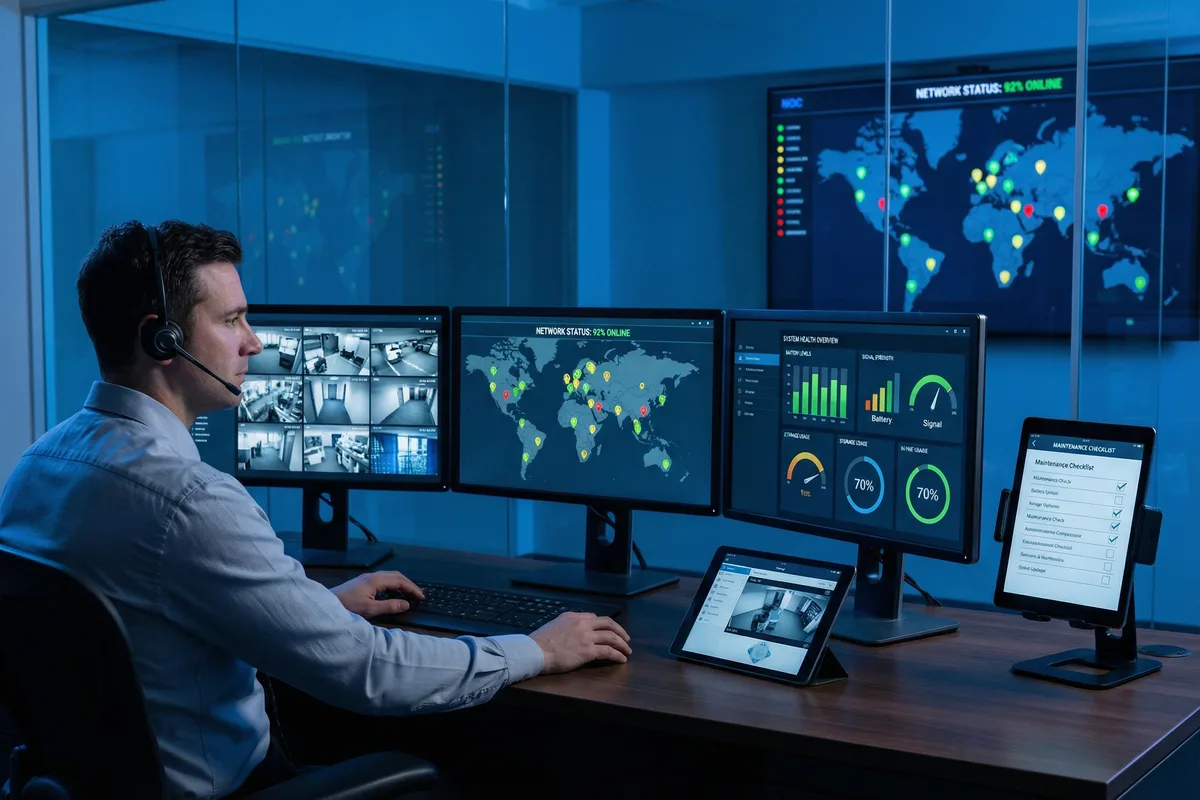
Figure 12.1: Remote monitoring and O&M operations center — NOC engineer monitoring a multi-screen dashboard showing site status map (green/yellow/red indicators), live camera feeds, system health metrics (battery levels, signal strength, storage usage), and maintenance checklist. Tablet showing mobile app for remote camera control.
12.1 Key Performance Indicators (KPIs)
The following KPIs define the minimum acceptable performance standards for an unattended surveillance site network. These metrics should be measured monthly and reported to the client. Sites that consistently fail to meet KPI targets require root-cause analysis and remediation plans.
12.2 Preventive Maintenance Schedule
Preventive maintenance for unattended sites is divided into remote tasks (performed from the NOC without a site visit) and on-site tasks (requiring physical presence at the site). Remote tasks should be performed more frequently to minimize the need for costly site visits.
| Frequency | Task Type | Task | Method | Responsible |
|---|---|---|---|---|
| Daily | Remote | Review NMS dashboard: site status, battery SoC, signal strength, recording status | NMS dashboard review; automated alert review | NOC Operator |
| Weekly | Remote | Review recording completeness for all cameras; check storage remaining; review alarm logs | NVR remote access; NMS reports | NOC Engineer |
| Monthly | Remote | Firmware review; check for security advisories; verify VPN certificate expiry dates; review bandwidth usage trends; generate KPI report | Vendor security bulletins; NMS reports | NOC Engineer |
| Quarterly | Remote | Firmware updates (if available); password rotation; review and update firewall rules; test alarm notification chain end-to-end | Remote management interface; VPN access | Security Engineer |
| 6-Monthly | On-Site | Physical inspection: camera aim, lens cleaning, bracket torque check, cable condition, cabinet seal inspection, desiccant replacement, ground resistance measurement | Site visit with inspection checklist; ground resistance tester | Field Technician |
| Annual | On-Site | Full preventive maintenance: all 6-monthly tasks plus battery capacity test, solar panel cleaning and output measurement, SPD replacement (if indicated), full acceptance re-test | Site visit with full tool kit; battery tester; solar irradiance meter | Senior Field Technician |
12.3 Remote Monitoring Framework
The remote monitoring framework defines the data that must be collected from each site, the alarm thresholds that trigger notifications, and the escalation procedure when alarms are not acknowledged within the required response time.
| Monitored Parameter | Collection Method | Warning Threshold | Critical Threshold | Response Time |
|---|---|---|---|---|
| Site Online Status | VPN heartbeat (60-second interval) | No heartbeat for 5 min | No heartbeat for 15 min | Warning: 30 min; Critical: immediate |
| Battery State of Charge (SoC) | MPPT controller MQTT/SNMP | SoC <40% | SoC <20% (low-voltage cutoff imminent) | Warning: 4h; Critical: 1h |
| Cabinet Temperature | Cabinet sensor MQTT | >45°C or <+5°C | >55°C or <-10°C | Warning: 2h; Critical: 30 min |
| Cellular Signal (RSRP) | Router SNMP/API | <-90dBm | <-100dBm (link failure risk) | Warning: 4h; Critical: 1h |
| Recording Status | NVR ONVIF/API | 1 camera not recording | All cameras not recording | Warning: 2h; Critical: 30 min |
| Storage Remaining | NVR SNMP/API | <20% remaining | <5% remaining | Warning: 24h; Critical: 4h |
| Cabinet Tamper | Tamper switch digital input | N/A | Door opened (immediate) | Critical: immediate (auto-escalate) |
12.4 Equipment Lifecycle Management
Proactive lifecycle management prevents unexpected failures by replacing equipment before it reaches end-of-life. The table below provides typical lifecycle estimates for the major components of an unattended surveillance site, based on manufacturer specifications and field experience in harsh outdoor environments.
| Component | Expected Lifespan | End-of-Life Indicators | Replacement Trigger |
|---|---|---|---|
| LiFePO4 Battery | 8–12 years (3000–5000 cycles) | SoH <80%; reduced autonomy; swelling | SoH <80% or >10 years in service |
| AGM Battery | 3–5 years | SoH <80%; reduced autonomy; electrolyte loss | SoH <80% or >4 years in service |
| Solar Panel | 20–25 years (0.5% annual degradation) | Output <80% of rated; delamination; cracked glass | Output <80% of rated or physical damage |
| MPPT Charge Controller | 10–15 years | Charging errors; efficiency loss; display failure | Charging errors not resolved by firmware update |
| IP Camera | 5–8 years | Image degradation; IR LED failure; housing seal failure | Image quality below acceptance threshold or housing failure |
| NVR / Edge Recorder | 5–7 years | HDD failures; performance degradation; firmware EOL | Firmware EOL or >2 HDD failures in 12 months |
| Cellular Router | 5–8 years | Frequent reboots; firmware EOL; hardware failure | Firmware EOL or hardware failure |
| SPD (Surge Protector) | Replace after any lightning event; otherwise 5–10 years | Fault indicator red; degraded protection level | After any confirmed lightning event; annual inspection |
O&M Best Practice: Maintain a site logbook (digital or physical) for every unattended site. Record every visit, every remote action, every alarm, and every component replacement with date, technician name, and description. The logbook is the single most valuable tool for diagnosing recurring issues, planning maintenance visits, and demonstrating due diligence to clients and auditors. A well-maintained logbook can reduce diagnostic time by 50% when investigating a site failure.