Selection & Interfaces
Chapter 5 · Unattended Surveillance Site Design Guide
5.1 Core Product Introduction
The five core product categories for unattended surveillance sites are illustrated below. Each product must be selected against the engineering specifications defined in Chapter 1 and the scenario requirements from Chapter 3. The product showcase shows the typical form factors for each category; actual products must be verified against the selection criteria table in Section 5.2.
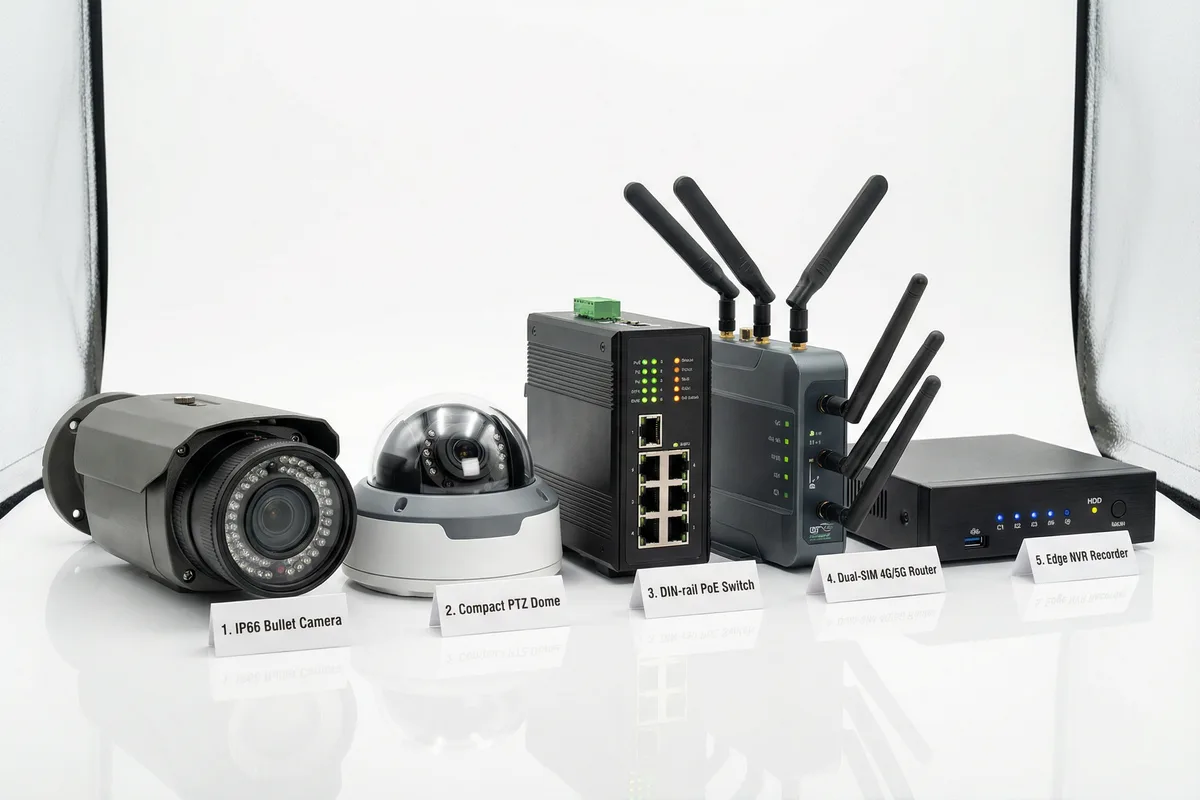
Figure 5.1: Core product lineup — (1) IP66 bullet camera, (2) compact PTZ dome, (3) DIN-rail industrial PoE switch, (4) dual-SIM 4G/5G router, (5) edge NVR recorder; professional studio photography showing industrial-grade form factors
Fixed IP Camera
PTZ Camera
Industrial PoE Switch
Industrial Dual-SIM Router
5.2 Selection Criteria & Comparison
The following table provides the complete selection criteria for each core product category, organized by the seven design dimensions from Chapter 2. Use this table as a procurement checklist and for comparing competing products during the selection process.
| Product | Must-Have Criteria | Industrial vs. Consumer Differentiator | Rejection Criteria |
|---|---|---|---|
| Fixed IP Camera | IP66+, -40°C min, Smart IR (no overexposure), WDR ≥120dB, H.265+, ONVIF Profile S | Industrial: metal housing, conformal-coated PCB, surge-protected ports; Consumer: plastic housing, no surge protection, limited temp range | Operating temp <-20°C; IP rating <IP65; no ONVIF; consumer-grade sensor with no WDR |
| PTZ Camera | Hi-PoE 60W or 24VAC, built-in heater/defog, preset accuracy ±0.1°, IP66, -40°C min, alarm-triggered positioning | Industrial: stainless steel fasteners, anti-condensation breather, auto-flip; Consumer: no heater, limited zoom range, no alarm integration | No heater in cold climate; PoE class <802.3at without external PSU; preset accuracy >0.5° |
| PoE Switch | Per-port PoE watchdog, total budget ≥ sum of all camera max loads × 1.25, -40°C, DIN-rail, VLAN/QoS | Industrial: surge-protected ports (4kV), conformal coating, wide temp, fanless; Consumer: no surge protection, limited temp, no DIN-rail | No per-port watchdog; PoE budget insufficient; operating temp <-20°C; no VLAN support |
| Industrial Router | Dual SIM from different bands, VPN ≥50Mbps, watchdog with auto-reboot, GPS/NTP, -40°C, SNMP v3 | Industrial: hardware watchdog, GPS sync, DIN-rail, wide temp, cellular diversity; Consumer: single SIM, no hardware watchdog, limited temp | Single SIM only; no hardware watchdog; VPN throughput <10Mbps; no SNMP monitoring |
| Edge NVR / AI Box | SMART monitoring with alerting, surveillance-rated storage, channel count ≥ camera count + 20%, AI analytics onboard | Industrial: SMART alert integration, wide temp, fanless option, redundant storage; Consumer: no SMART alerting, limited channels, no AI | No SMART monitoring; consumer HDD in 24/7 recording; channel count at maximum (no headroom) |
5.3 Typical Wiring & Interface Logic
The interface logic diagram below illustrates the complete connection map for a standard 4-camera site, showing all physical ports, cable types, PoE classes, and grounding connections. This diagram serves as the basis for the as-built wiring documentation required at acceptance.
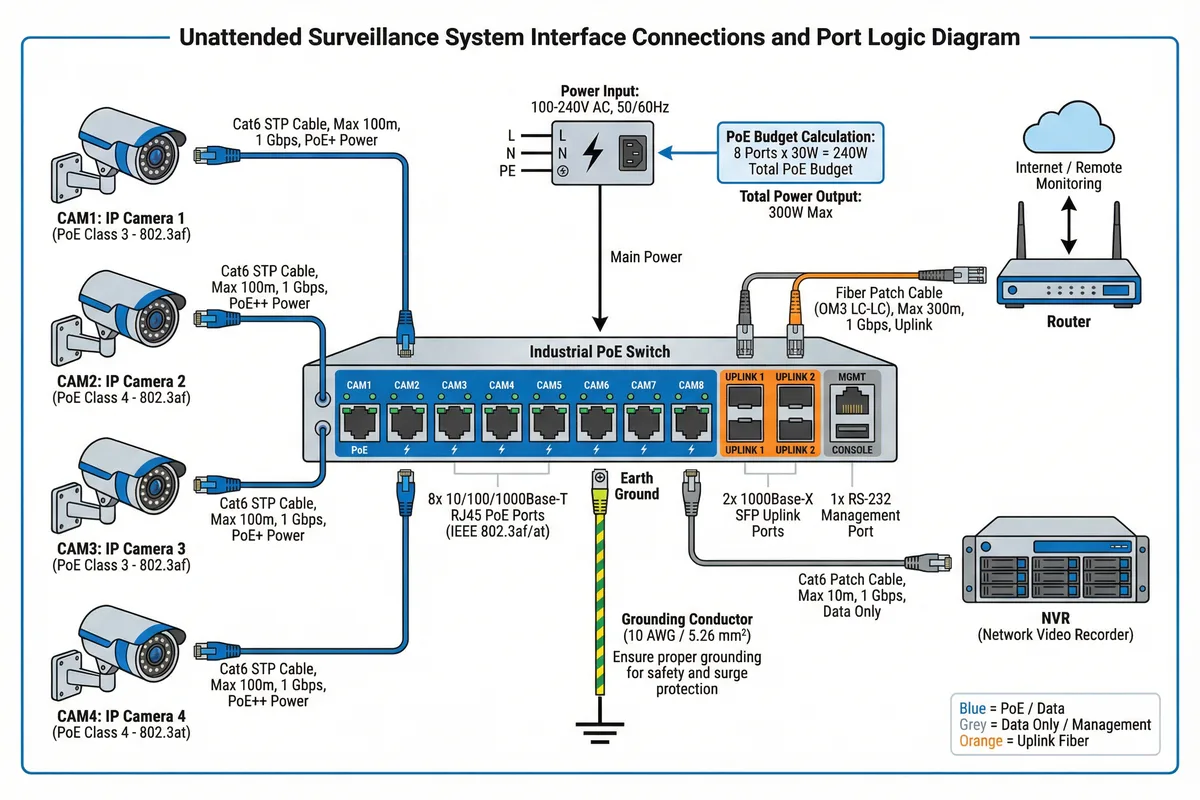
Figure 5.2: Interface connections and port logic diagram — industrial PoE switch central hub with 8× PoE RJ45 ports (CAM1–CAM8), 2× SFP uplink, 1× management port; camera connections with PoE class labels, router and NVR connections, PoE budget calculation, and grounding conductor detail
5.3.1 Core Product Feature Comparison Table
| Feature | Fixed Camera | PTZ Camera | PoE Switch | Router | Edge NVR |
|---|---|---|---|---|---|
| Operating Temp -40°C | ✓ | ✓ | ✓ | ✓ | ✓ |
| IP66 or Higher | ✓ | ✓ | DIN-rail (indoor) | DIN-rail (indoor) | DIN-rail (indoor) |
| Surge Protection (4kV) | ✓ | ✓ | ✓ | ✓ | ✓ |
| ONVIF Profile S/G | ✓ | ✓ | N/A | N/A | ✓ |
| Hardware Watchdog | ✓ (reboot) | ✓ (reboot) | ✓ (per-port) | ✓ (system) | ✓ (system) |
| Remote Management | ONVIF / API | ONVIF / API | SNMP v3 / SSH | SNMP v3 / API / TR-069 | ONVIF / API / SNMP |
| AI Analytics | ✓ (edge) | ✓ (edge) | ✗ | ✗ | ✓ (central) |
| SMART / Health Telemetry | Reboot count, temp | Reboot count, temp, position | Port status, PoE power | RSSI, latency, failover count | SMART, free space, write rate |
| Dual Power Input | ✗ | ✗ | ✓ (redundant PSU option) | ✓ (dual input) | ✓ (RAID-1 option) |
| DIN-Rail Mounting | ✗ | ✗ | ✓ | ✓ | ✓ |
Interface Compatibility Note: Before finalizing the BoQ, verify that the selected camera's PoE class does not exceed the switch's per-port budget. A PTZ camera requiring 60W (Hi-PoE / 802.3bt) cannot be powered by a standard 802.3at (30W) switch port. Verify that the NVR's channel license count matches the camera count, and that the router's VPN throughput is sufficient for the aggregate uplink bitrate of all cameras during an alarm event.